
U.S. Voting System Owned by Republicans
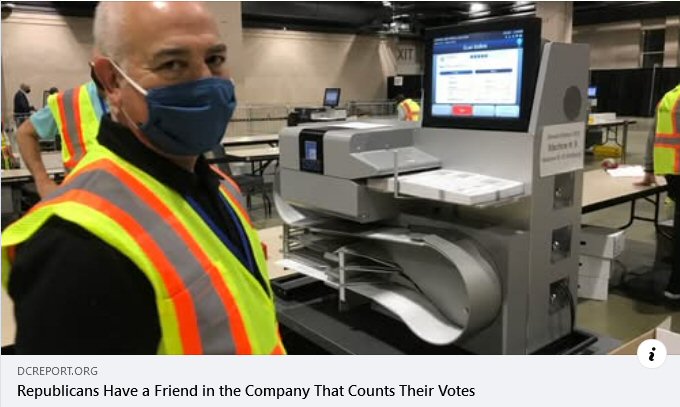
ES&S Voting Systems: A Friend To Republicans
Per the above article: Raising Some Questions about the Voting Machine Company Behind So Many Surprise Wins This Year
After initially focusing on the surprisingly lopsided results of the senatorial election in Kentucky, DCReport broadened our scope to look at the electronic vote-counting software and electronic voting systems that we rely on to tally our votes. This prompted us to raise questions about Electronic Systems & Software (ES&S), America’s largest voting machine company. What we found was a revolving door between government officials and ES&S.
Voting results in three states that saw surprising majorities by vulnerable incumbent Republican senators—Maine, North Carolina and South Carolina—were almost all tabulated on ES&S machines.
Trump attorneys Rudy Giuliani and Sydney Powell and Fox hosts have been making such bold and naked claims against the ES&S competitors, without any substance or evidence, that Fox News, NewsMax and OAN have all been threatened with litigation unless they fully retract their claims and correct a number of egregious factual errors.
Team Trump has been so vigorous in going after Dominion that it prompted us to look into how ES&S operates. What we have found so far is far from comforting.
- Owned by a private equity firm, ES&S has been elusive about identifying the people in its ownership.
- A number of ES&S executives and lobbyists have ties to top GOP election officials and politicians.
- The ES&S executive in charge of the security previously worked in the Trump administration as a government executive at Health and Human Services before leaving under a cloud.
- Forty of the 50 states use ES&S to cast and count some of their votes.
- Of the 25 states Trump won, all but 3 either partially or fully relied on ES&S machines. The states where Trump won that didn’t use ES&S machines were Oklahoma, Louisiana and Alaska.
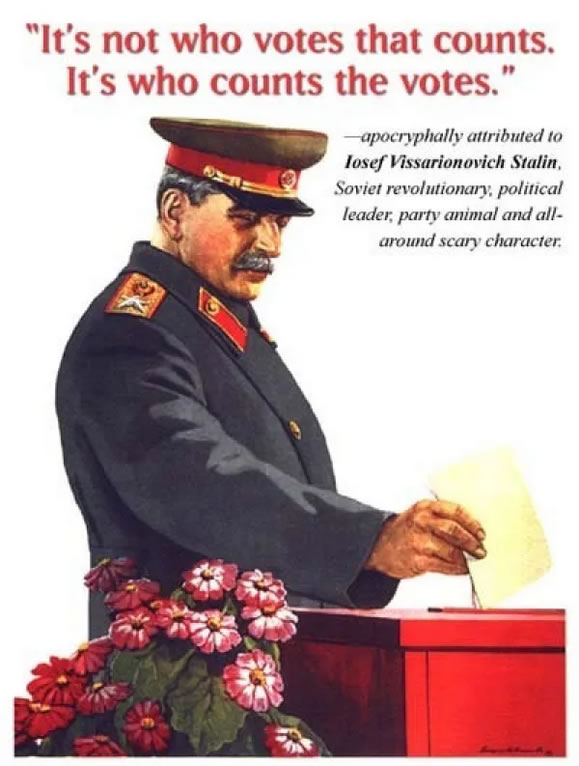
https://abcnews.go.com/US/dominion-voting-systems-sold-company-run-former-republican/story?id=126378259
Per the above article: “Dominion Voting Systems has been sold to a seemingly new election company run by a former Republican election official, according to a person familiar with the sale.”
John Poulos, the former Dominion CEO, confirmed the sale in a statement. “Liberty Vote has acquired Dominion Voting Systems,” Poulos said.
Voting systems made by Dominion, one of the most-used voting machine companies in the U.S., were used in 27 states in during the 2024 election.
In a statement, Liberty Vote said it is founded and run by Scott Leiendecker, whose LinkedIn profile says he served as the election director for the city of St. Louis until 2012. News articles from the time indicate he was a Republican.
Voting systems and software in the United States have Republican Owners & Presidents as detailed in this Google search
In October 2025, Dominion Voting Systems was acquired by a newly formed company, Liberty Vote, which is run by a former Republican election official, Scott Leiendecker.
Another major vendor, Election Systems & Software (ES&S), is owned by a private equity firm with past ties to a Republican investor.
Dominion Voting Systems (now Liberty Vote)
Ownership: The company was purchased by Liberty Vote, a firm founded and run by Scott Leiendecker, who previously served as an election director in St. Louis and is a former Republican election official.
Political Alignment/Messaging: The new ownership has embraced language and priorities aligning with President Donald Trump’s calls for election reforms, such as emphasizing hand-marked paper ballots and 100% American ownership. This messaging contrasts with Dominion’s prior non-partisan stance and was unexpected by some state election officials.
Usage: Dominion’s systems are widely used, having processed votes in over half the states during the 2024 election.
Impact on Systems: Despite the change in ownership and messaging, election officials were told that no immediate staff changes, contract terminations, or product overhauls were expected, and that the existing systems still comply with current federal and state laws.
Election Systems & Software (ES&S)
Ownership: ES&S is a privately owned company, which means it is not legally obligated to reveal all ownership details. A controlling interest is held by the Omaha-based private equity firm McCarthy Group.
Political Ties: An ES&S spokesperson has confirmed in the past that its investors are U.S. citizens or entities. Historically, the company was purchased in 1977 by an investment firm owned by Republican Prentis Cobb Hale, a strong supporter of Ronald Reagan, and some company founders had Republican leanings. ES&S executives and lobbyists have also had ties to GOP officials and politicians.
Usage: ES&S is one of the largest election equipment vendors in the U.S., used by 40 of the 50 states to cast and count votes.
Other Major Vendors
Hart InterCivic: This is the third major vendor in the U.S., and it is also owned by a private equity firm that is not obligated to disclose its investors.
Smartmatic: This company has faced conspiracy theories regarding links to Venezuelan leadership, which have been widely debunked through defamation lawsuits and by election experts. It operates in several countries and is a competitor to Dominion.
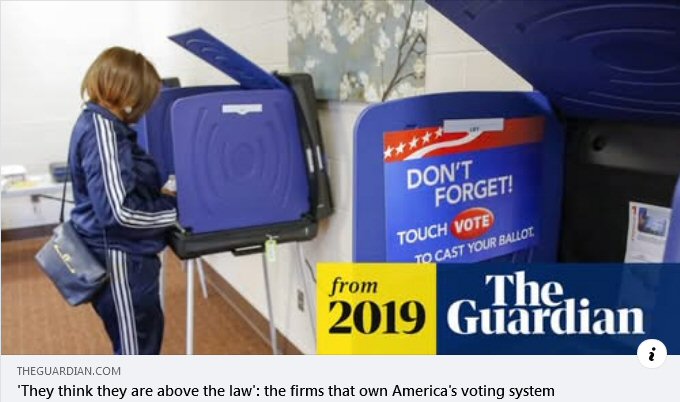
‘They think they are above the law’: the firms that own America’s voting system
Per the above article: Maryland congressman Jamie Raskin is a newcomer to the cause of reforming America’s vote-counting machines, welcomed through baptism by fire. In 2015, Maryland’s main election system vendor was bought by a parent company with ties to a Russian oligarch. The state’s election officials did not know about the purchase until July 2018, when the FBI notified them of the potential conflict.
The FBI investigated and did not find any evidence of tampering or sharing of voter data. But the incident was a giant red flag as to the potential vulnerabilities of American democracy – especially as many states have outsourced vote-counting to the private sector. After all, the purchase happened while Russian agents were mounting multiple disinformation and cybersecurity campaigns to interfere with America’s 2016 general election.
The fact is that democracy in the United States is now largely a secretive and privately-run affair conducted out of the public eye with little oversight. The corporations that run every aspect of American elections, from voter registration to casting and counting votes by machine, are subject to limited state and federal regulation.
The companies are privately-owned and closely held, making information about ownership and financial stability difficult to obtain. The software source code and hardware design of their systems are kept as trade secrets and therefore difficult to study or investigate.
The market for election vendors is small and the “customer base” mostly limited to North America and centered on the US, meaning that competition is fierce. The result is a small network of companies that have near-monopolies on election services, such as building voting machines. Across the spectrum, private vendors have long histories of errors that affected elections, of obstructing politicians and the public from seeking information, of corruption, suspect foreign influence, false statements of security and business dishonesty.
But these companies are the safekeepers of American democracy.
A corner of the computer security world has been sounding the alarm since voting machines were adopted after the punch-card disaster of the 2000 election recount in Florida. Now lawmakers, election officials and national security experts are joining in on the clamor after Russian agents probed voting systems in all 50 states, and successfully breached the voter registration systems of Arizona and Illinois in 2016.
Both Robert Mueller’s report and a previous indictment of 12 Russian agents confirmed Russians also targeted private vendors that provided election software. The Russians successfully breached at least one company, its name redacted in the reports, “and installed malware on the company network”, according to the Mueller report.
Intelligence agencies expect cyber attacks from Russia, China and other nations against America’s democracy to continue in 2020.
Oregon senator Ron Wyden, in a speech at an election security conference in Washington DC, said that the voting machine lobby “literally thinks they are just above the law, they are accountable to nobody, [and] they have been able to hotwire the political system in certain parts of the country like we’ve seen in Georgia”.
Wyden was referring to the fact that Brian Kemp, who is now Georgia’s governor after overseeing his own election while secretary of state, appointed an ES&S lobbyist as his deputy chief of staff. Meanwhile, the state is in the process of purchasing more than $150m in new voting machines.
“My view is that the maintenance of our constitutional rights should not depend on the sketchy ethics of these well-connected corporations that stonewall Congress, lie to public officials and have repeatedly gouged taxpayers,” Wyden said.
Meanwhile, weak state or federal guidance leaves many cybersecurity companies doing whatever they want, according to Joshua M Franklin, president and co-founder of Outstack Technologies, a cybersecurity company that helps protect campaign and election infrastructure.
“There are no technical standards or best practices from the US federal government on the security of voter registration systems,” Franklin said. “One to two pages [of guidelines] don’t cut it. Similarly, we are missing technical security specifications that election night reporting or blank ballot distribution systems must meet.”
Like voting machine vendors, companies providing voter registration and election-night reporting services have their own history with security lapses and false statements. Very little is known about the contracts and relationships between states and vendors such as PCC and Scytl that provide voter registration or other online election services.
When it was discovered three days before the 2018 midterms that poor cybersecurity left Georgia’s voter registration system vulnerable to being altered, it was unclear whether the state or the company were responsible for the failures. Computer security experts tested the systems of two other states also listed as clients by PCC. One of the coding problems also existed in North Carolina and Washington, though the way the states structured their websites muted the potential hazard faced in Georgia.
Not only are the companies largely free from public records requests, they are often asked to investigate or police themselves, according to election law expert Candice Hoke.
“It is unheard of, for instance in a bank, that if they have anomalies or a potential hack that they need to investigate, that they are supposed to call the software licensor or the software company and get them to examine their own software and decide whether their software was hacked or flawed in some way,” Hoke said. “Absolutely preposterous. And yet we allow that in our elections.”
https://columbusfreepress.com/article/diebold-indicted-its-spectre-still-haunts-ohio-elections
Per the above article by Bob Fitrakis and Harvey Wasserman posted October 31st 2013
Diebold: the controversial manufacturer of voting and ATM machines, whose name conjures up the demons of Ohio’s 2004 presidential election irregularities, is now finally under indictment for a “worldwide pattern of criminal conduct.” Federal prosecutors filed charges against Diebold, Inc. on Tuesday, October 22, 2013 alleging that the North Canton, Ohio-based security and manufacturing company bribed government officials and falsified documents to obtain business in China, Indonesia and Russia. Diebold has agreed to pay $50 million to settle the two criminal counts against it. This is not the first time Diebold’s been accused of bribery.
In 2005, the Free Press exposed that Matt Damschroder, Republican chair of the Franklin County of Elections in 2004, reported that a key Diebold operative told Damschroder he made a $50,000 contribution to then-Ohio Secretary of State J. Kenneth Blackwell’s “political interests” while Blackwell was evaluating Diebold’s bids for state purchasing contracts. Damschroder admitted to personally accepting a $10,000 check from former Diebold contractor Pasquale “Patsy” Gallina made out to the Franklin County Republican Party. That contribution was made while Damschroder was involved in evaluating Diebold bids for county contracts. Damschroder was suspended for a month without pay for the incident. Despite the scandal, he was later appointed as Ohio Secretary of State Jon Husted’s Director of Elections.
The ghosts of 2004 election irregularities Diebold was at the center of Ohio’s 2004 election debacle, much of this captured in an article by Free Press Senior Editor Harvey Wasserman and this author, entitled, “Diebold’s Political Machine.” Walden “Wally” O’Dell, chairman of the board and chief executive of Diebold, was a long-time funder of Republican candidates. In September 2003, he held a packed $1,000-per-head GOP fundraiser at his 10,800-square-foot mansion Cotswold Manor in Upper Arlington, Ohio. He was feted as a guest at then-President George W. Bush’s Texas ranch, joining a cadre of “Pioneers and Rangers” who pledged to raise more than $100,000 for the Bush reelection campaign. Most memorably, in 2003 O’Dell penned a letter pledging his commitment “to helping Ohio deliver its electoral votes to the President.” O’Dell defended his actions, telling the Cleveland Plain Dealer “I’m not doing anything wrong or complicated.” But he also promised to lower his political profile and “try to be more sensitive.” But the Diebold boss’ partisan cards were squarely on the table. Prior to the 2004 election, Blackwell tried to award a $100 million unbid contract to Diebold for electronic voting machines.
A storm of public outrage and a series of lawsuits forced him to cancel the deal. But a substantial percentage of Ohio’s 2004 votes were counted by Diebold software and Diebold Opti-scan machines which frequently malfunctioned in the Democratic stronghold of Toledo. It was revealed in 2006 that Blackwell owned Diebold stock. Diebold’s GEMS election software was used in about half of Ohio counties in the 2004 election. Because of Blackwell’s effort, 41 counties also used Diebold machines in Ohio’s highly dubious 2005 election. Also in the Ohio 2004 election, a whistleblower leaked documents revealing that Diebold had allegedly used illegal, uncertified hardware and software during California election. The ghosts in the Diebold election machines go bump in the 2002 election Wherever Diebold and the other most well-known voting machine company Election Systems & Software (ES&S) go, irregularities and historic Republican upsets follow. Alastair Thompson, writing for scoop.co of New Zealand, explored whether or not the 2002 U.S. mid-term elections were “fixed by electronic voting machines supplied by Republican-affiliated companies.”
The Scoop investigation concluded that: “The state where the biggest upset occurred, Georgia, is also the state that ran its election with the most electronic voting machines.” Those machines were supplied by Diebold. ES&S and Diebold would later merge and now count about 80 percent of all U.S. votes. Wired News reported that “. . . a former worker in Diebold’s Georgia warehouse says the company installed patches on its machine before the state’s 2002 gubernatorial election that were never certified by independent testing authorities or cleared with Georgia election officials.” Questions were raised in Texas when three Republican candidates in Comal County each received exactly the same number of votes – 18,181 – on ES&S machines.
Following the 2003 California election, an audit of the company revealed that Diebold Election Systems voting machines installed uncertified software in all 17 counties using its equipment. In 2012, Ohio Secretary of State Jon Husted approved a secret last-minute contract allowing ES&S to install untested, “experimental” software patches on central voting tabulators in 39 Ohio counties. Congressional testimony exposed that last-minute patches were installed in several Ohio counties including Miami and Clermont in the 2004 election. Johns Hopkins researchers at the Information Security Institute issued a report declaring that Diebold’s electronic voting software contained “stunning flaws.”
The researchers concluded that vote totals could be altered at the voting machines and by remote access. Diebold vigorously refuted the Johns Hopkins report, claiming the researchers came to “a multitude of false conclusions.” Perhaps to settle the issue, apparently an insider leaked documents from the Diebold Election Systems website and posted internal documents from the company to Bev Harris’ Black Box Voting website. Diebold went to court to stop, according to court records, the “wholesale reproduction” of some 13,000 pages of company material. The Associated Press reported in November 2003 that: “Computer programmers, ISPs and students at at least 20 universities, including the University of California, Berkeley and the Massachusetts Institute of Technology received cease and desist letters” from Diebold. A group of Swarthmore College students launched an “electronic civil disobedience” campaign to keep the hacked documents permanently posted on the Internet.
Diebold computer goblin causes the 2000 election to be called for Bush The rush to embrace computerized voting, of course, began with Florida’s 2000 presidential election. But, in fact, one of the Sunshine State’s election-day disasters was the direct result of a malfunctioning computerized voting system; a system built by Diebold. The massive screw-up in Volusia County was all but lost in the furor over hanging chads and butterfly ballots in South Florida. In part that is because county election officials avoided a total disaster by quickly conducting a hand recount of the more than 184,000 paper ballots used to feed the computerized system. But the huge computer miscount led several networks to incorrectly call the race for Bush. The first to call it was Fox News where Bush’s first cousin, John Ellis, was in charge of election night coverage.
The first signs that the Diebold-made system in Volusia County was malfunctioning came early on election night, when the central ballot-counting computer showed a Socialist Party candidate receiving more than 9,000 votes and Vice President Al Gore getting minus 19,000. Another 4,000 votes poured into the plus column for Bush that didn’t belong there. Taken together, the massive swing seemed to indicate that Bush, not Gore, had won Florida and thus the White House. Election officials restarted the machine, and expressed confidence in the eventual results, which showed Gore beating Bush by 97,063 votes to 82,214. After the recount, Gore picked up 250 votes, while Bush picked up 154. But the erroneous numbers had already been sent to the media.
Harris has posted a series of internal Diebold memos relating to the Volusia County miscount on her website, blackboxvoting.com. One memo from Lana Hires of Global Election Systems, now part of Diebold, complains, “I need some answers! Our department is being audited by the County. I have been waiting for someone to give me an explanation as to why Precinct 216 gave Al Gore a minus 16,022 [votes] when it was uploaded.” Another, from Talbot Ireland, Senior VP of Research and Development for Diebold, refers to key “replacement” votes in Volusia County as “unauthorized.” Harris has also posted a post-mortem by CBS detailing how the network managed to call Volusia County for Bush early in the morning. The report states: “Had it not been for these [computer] errors, the CBS News call for Bush at 2:17:52 AM would not have been made.”
As Harris notes, the 20,000-vote error shifted the momentum of the news reporting and nearly led Gore to concede. It also gave rise to the incorrect chant that, “Bush won twice.” What’s particularly troubling, Harris says, is that the errors were caught only because an alert poll monitor noticed Gore’s vote count going down through the evening, which of course is impossible. Diebold blamed the bizarre swing on a “faulty memory chip,” which Harris claims is simply not credible. The whole episode, she contends, could easily have been consciously programmed by someone with a partisan agenda. Such claims might seem far-fetched, were it not for the fact that a cadre of computer scientists showed a year ago that the software running Diebold’s new machines can be hacked with relative ease. In 2006, Princeton computer scientists revealed that a computer virus could be easily implanted on a Diebold AccuVote Touch Screen voting system allowing the vote to be flipped. Professor Edward Felten noted that a single individual, “with just one or two minutes of unsupervised access to either the voting machine or the memory card” could rig the system.
Carnegie Mellon’s Michael Shamos called the discovery “the most severe security flaw ever discovered in a voting system.” Diebold sued over faulty equipment, settles by giving away more faulty equipment Cuyahoga County (Cleveland, Ohio) election officials accused Diebold of breach of contract, negligence and fraud following the 2008 Ohio primary. Then-Ohio Secretary of State Jennifer Brunner sued Diebold for breach of contract, warranty violations and misrepresentations by Diebold representatives involving 47 Ohio counties. In a bizarre settlement in 2010, more than half of Ohio’s county boards of elections received free and discounted voting machines and software from Premier Election Solutions (formally Diebold). This is a result of the August 2008 lawsuit against Diebold filed by Brunner.
In the counterclaim filed by Brunner, she alleged that Diebold voting equipment “dropped votes in at least 11 counties.” The failure to count votes occurred when Diebold memory cards were uploaded to computer servers. Diebold in 2010 reached a settlement with the Securities and Exchange Commission (SEC) after the U.S. government sued them for $25 million in a fraud case. Diebold admitted that they had overstated the value of their election division by 300% in a stock manipulation scheme. U.S. Attorney Steven Dettelbach noted that “Companies that pay bribes to public officials, whether those officials are in Cleveland, in Ohio, or overseas, violate the law.” Amen. Why would a free people allow a company with Diebold’s track record to have anything to do with our elections at all. The Diebold indictment underscores a much greater problem in the U.S. election system. As long as the United States allows corrupt, partisan private corporations to secretly count its votes, democracy remains in danger.
Per a Google search result: The association between Diebold and the Republican party primarily stems from the activities and statements of its former chairman and CEO, Walden “Wally” O’Dell, in the early 2000s, when the company had a division that produced voting machines. The current company, Diebold Nixdorf, is a publicly traded corporation with diverse institutional shareholders and is no longer in the election systems business.
Past Political Controversy
CEO’s Political Statements: In August 2003, O’Dell, a major Republican donor and Bush campaign organizer, wrote a fundraising letter to Ohio Republicans stating he was “committed to helping Ohio deliver its electoral votes to the president next year”.
Conflict of Interest Concerns: This statement, combined with the fact that Diebold Election Systems was a potential supplier of new electronic voting machines in Ohio, raised significant concerns about partisanship and potential conflicts of interest regarding election integrity.